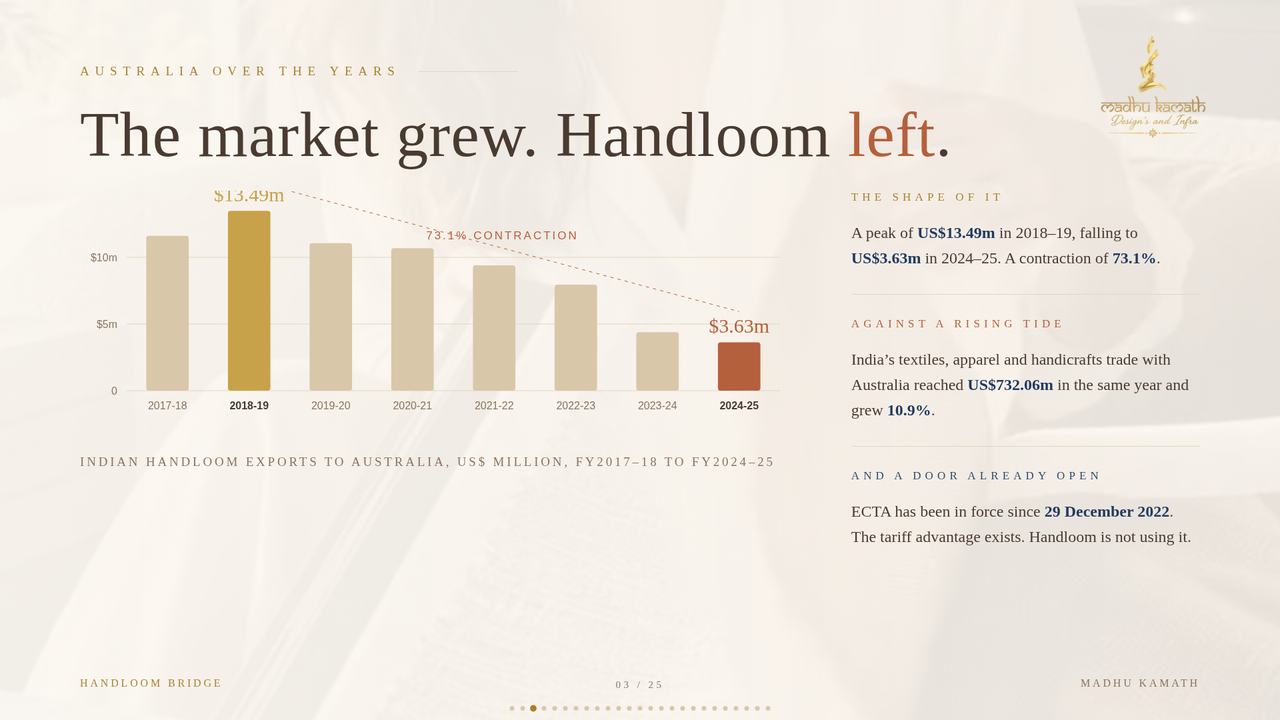

The market grew. Handloom left.
Indian handloom exports to Australia, US$ million, FY2017–18 to FY2024–25
A peak of US$13.49m in 2018–19, falling to US$3.63m in 2024–25. A contraction of 73.1%.
India’s textiles, apparel and handicrafts trade with Australia reached US$732.06m in the same year and grew 10.9%.
ECTA has been in force since 29 December 2022. The tariff advantage exists. Handloom is not using it.
Every intervention worked.
Then it stopped.
Melbourne in 2014, 2016 and 2018. Sydney in 2017. The Fashion Festival in 2019. A virtual edition in 2021. The Powerhouse in 2022, opening to more than two hundred guests. Buyers came. Orders were written. Interest was real.
Then each one closed. The samples went home. The buyers moved to the next season. Nothing here carried the relationship forward, so the next visit began again from nothing, in front of people who had forgotten the last one.
The gap is not exposure. It is continuity.
A market is not built in the week an exhibition is open. It is built in the fifty-one weeks afterwards, by someone here, holding the relationships, reading what buyers actually want, and carrying that back to the loom in time for the next season.
India has the capability. Australia has the appetite. What has never existed is the bridge between them.
The capability already exists.
Materials, weaves and archives
Sampling and product development
Production capacity and quality control
Logistics and coordination
More than fifteen hundred exporters, and a home textile capability that already accounts for the majority of handloom exports, which is precisely where Australian demand sits.
India knows how to make. This programme is about knowing, precisely and continuously, what to make for here, and getting that answer back to the loom while it still matters.
The back end is ready. The front end is what we are building.
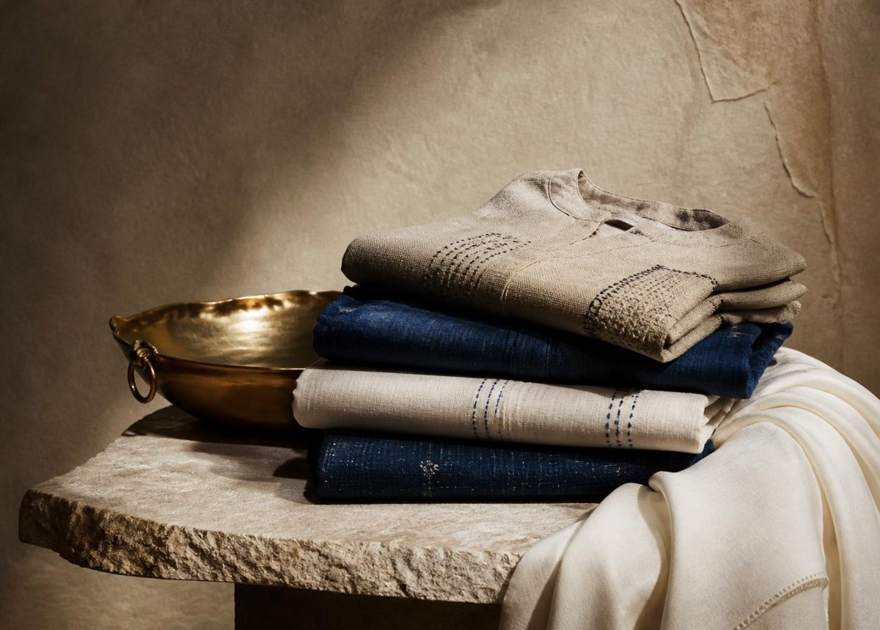
Keep the essence. Adapt.
Hand
Provenance
Technique
The knowledge held in the loom
Scale
Silhouette
Application
Fit, performance and care
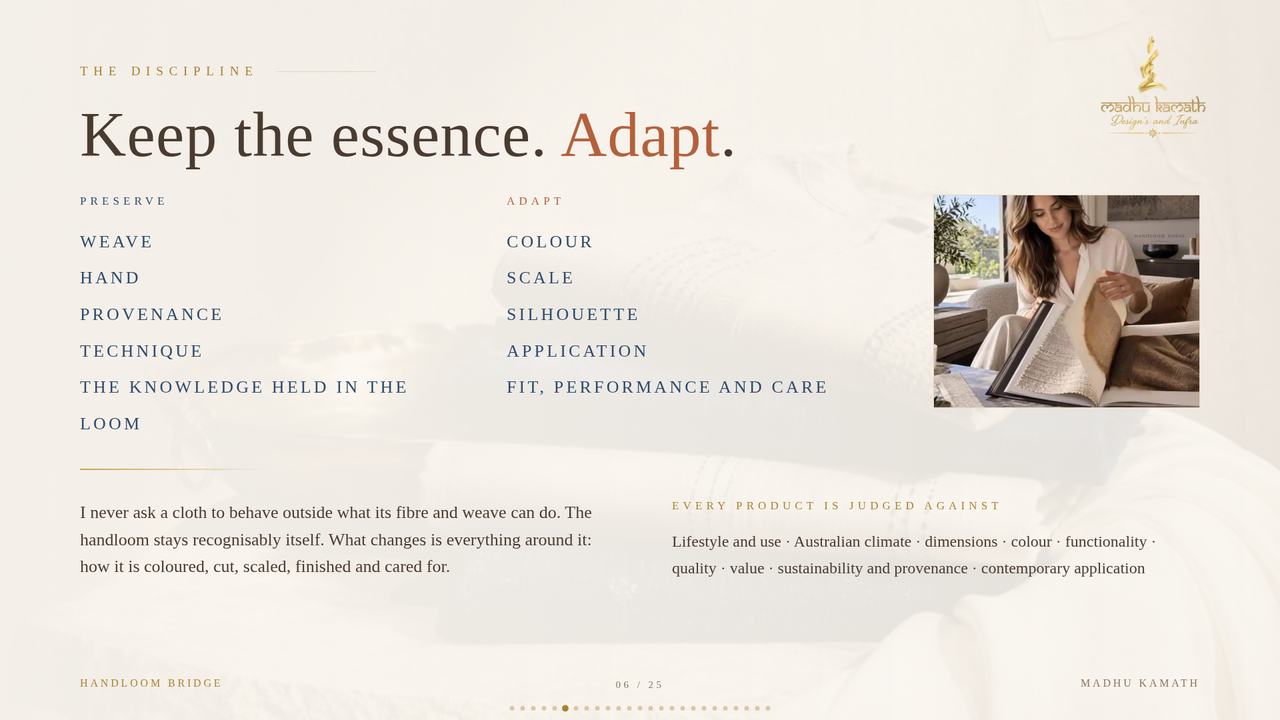
We work backwards from Australian life, use and market demand to the loom, while keeping the hand, weave, provenance and maker identity non-negotiable. The cloth stays recognisably itself; we adapt colour, scale, silhouette, application, fit, performance and care.
Lifestyle and use · Australian climate · dimensions · colour · functionality · quality · value · sustainability and provenance · contemporary application
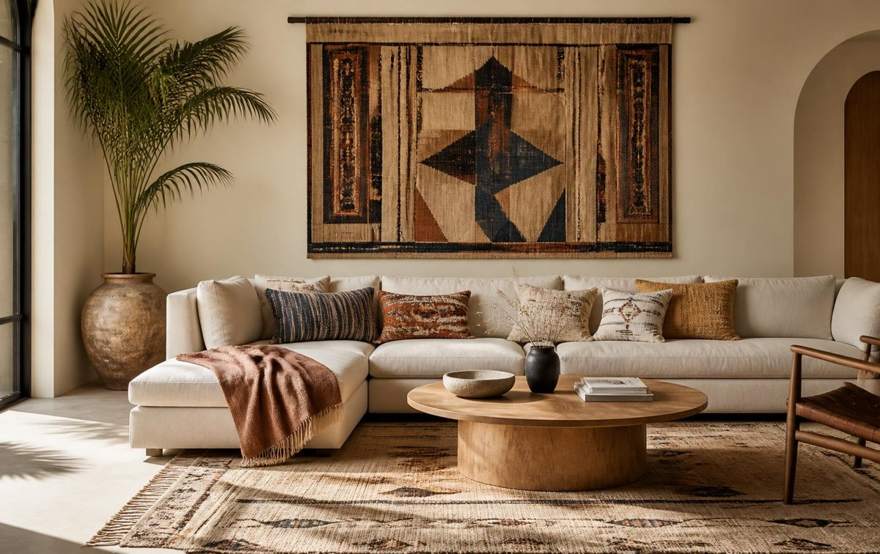
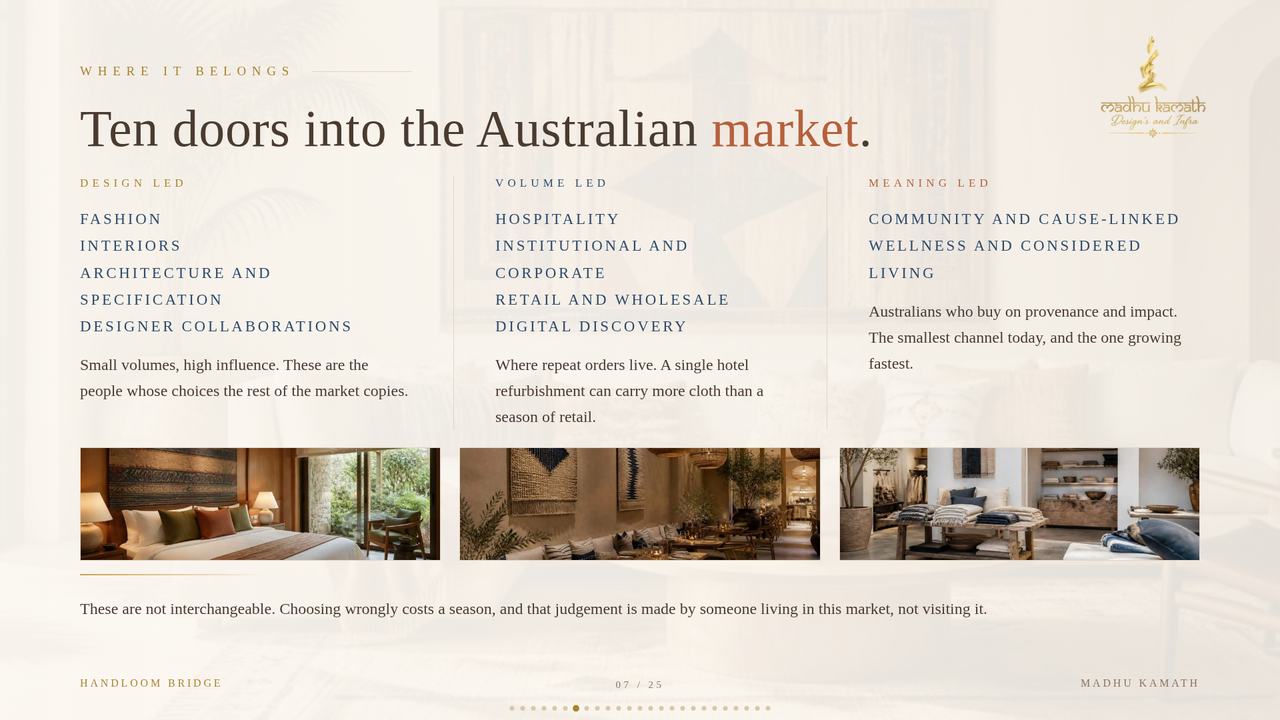
Ten doors into the Australian market.
Interiors
Architecture and specification
Designer collaborations
Small volumes, high influence. These are the people whose choices the rest of the market copies.
Institutional and corporate
Retail and wholesale
Digital discovery
Where repeat orders live. A single hotel refurbishment can carry more cloth than a season of retail.
Wellness and considered living
Australians who buy on provenance and impact. The smallest channel today, and the one growing fastest.
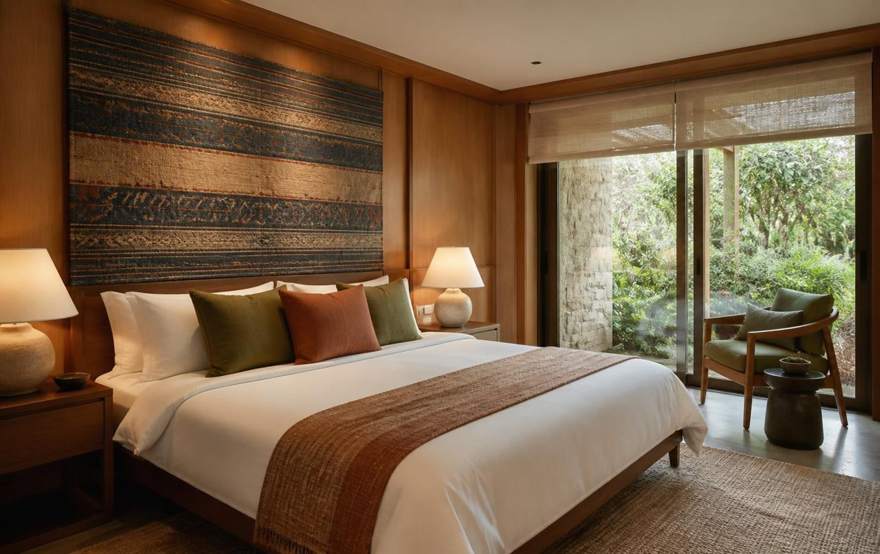
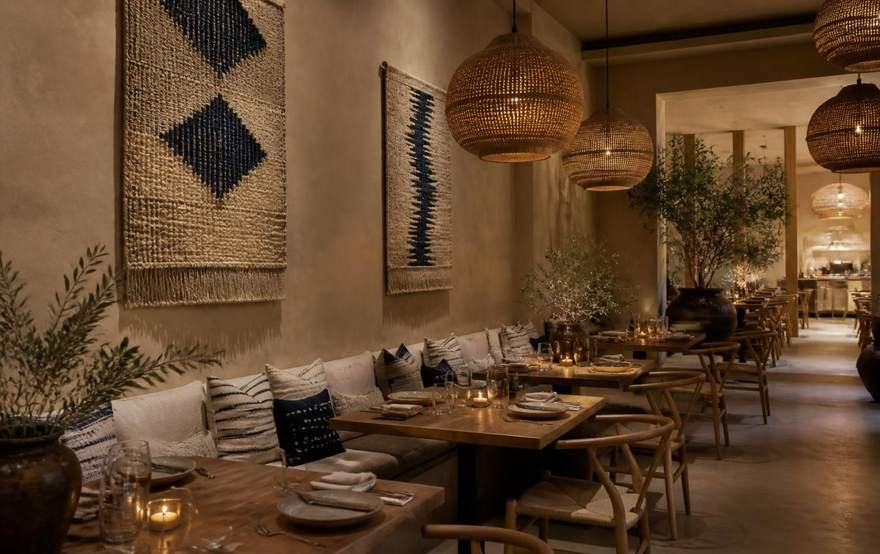
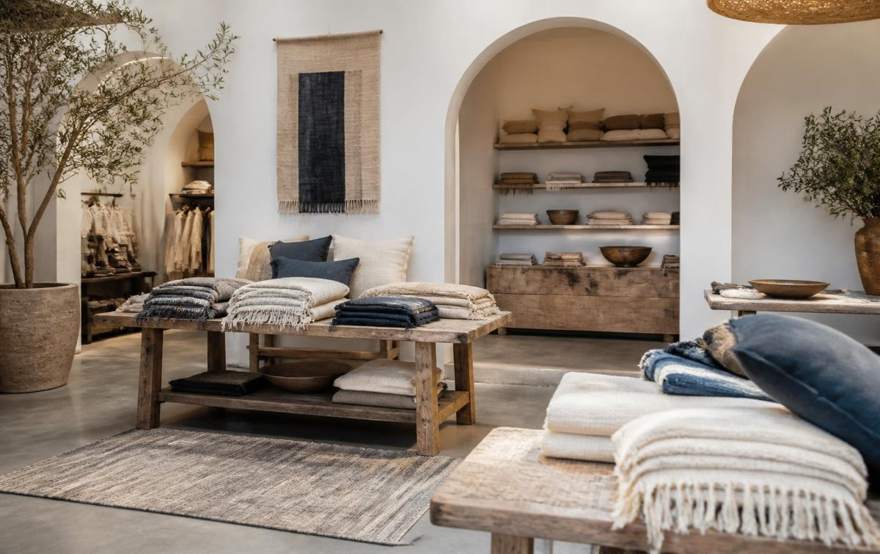
These are not interchangeable. Choosing wrongly costs a season, and that judgement is made by someone living in this market, not visiting it.
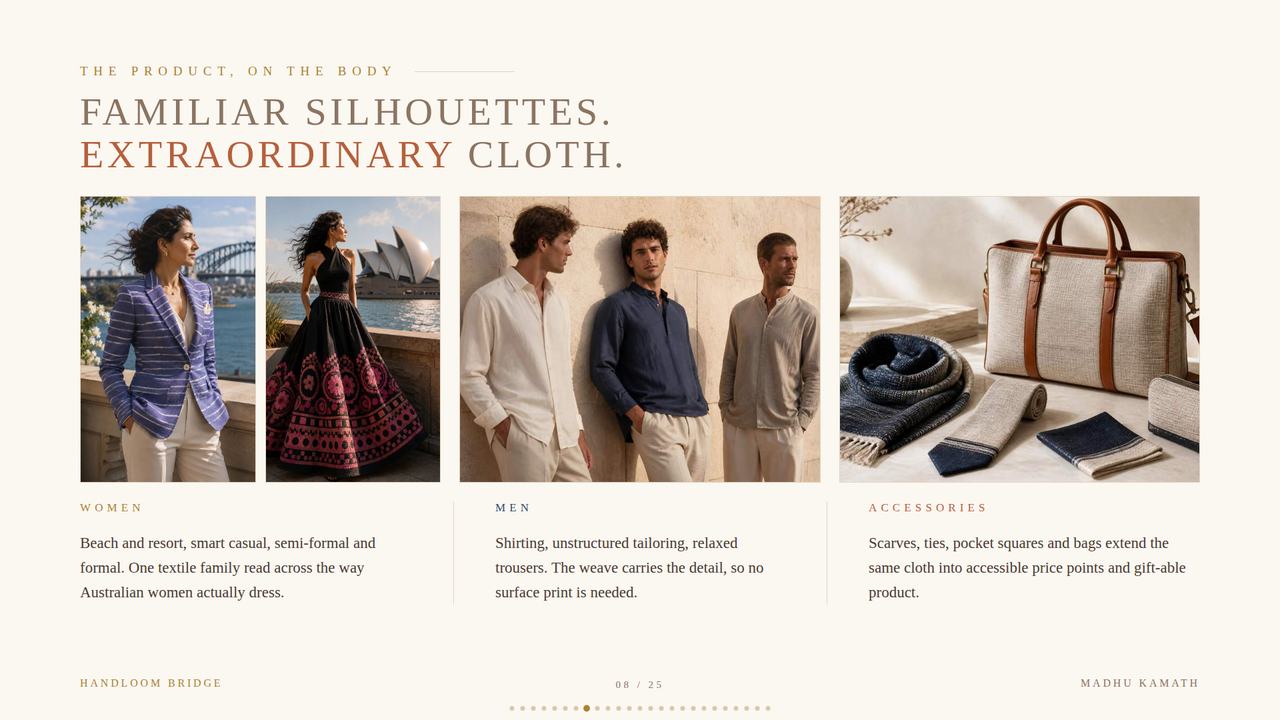
Familiar silhouettes.
Extraordinary cloth.

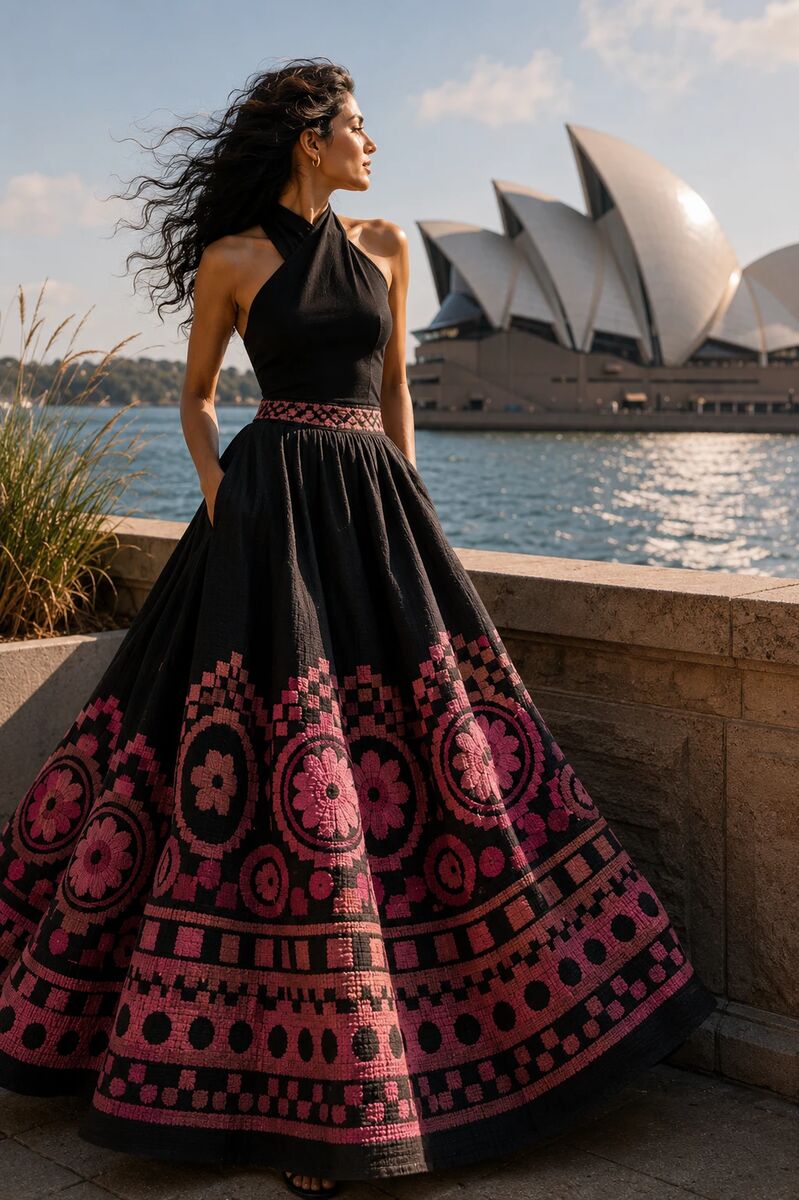

Beach and resort, smart casual, semi-formal and formal. One textile family read across the way Australian women actually dress.
Shirting, unstructured tailoring, relaxed trousers. The weave carries the detail, so no surface print is needed.
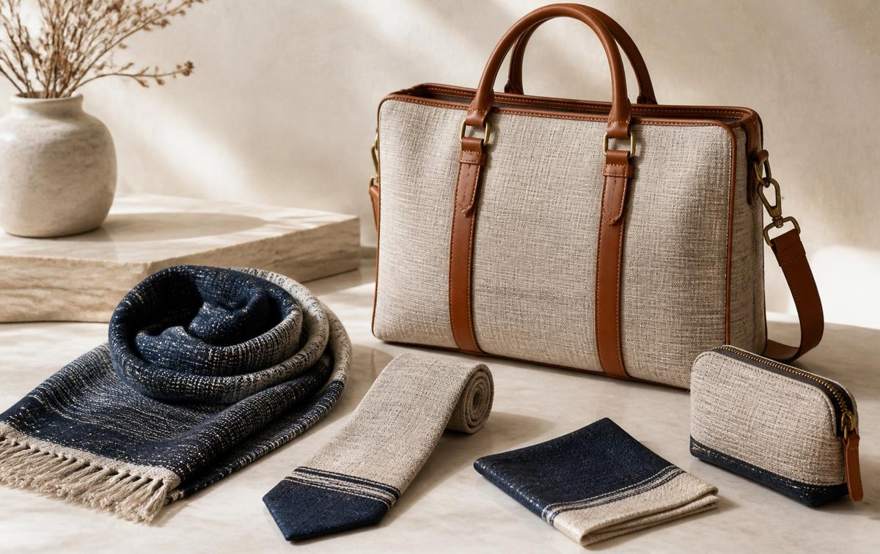
Scarves, ties, pocket squares and bags extend the same cloth into accessible price points and gift-able product.
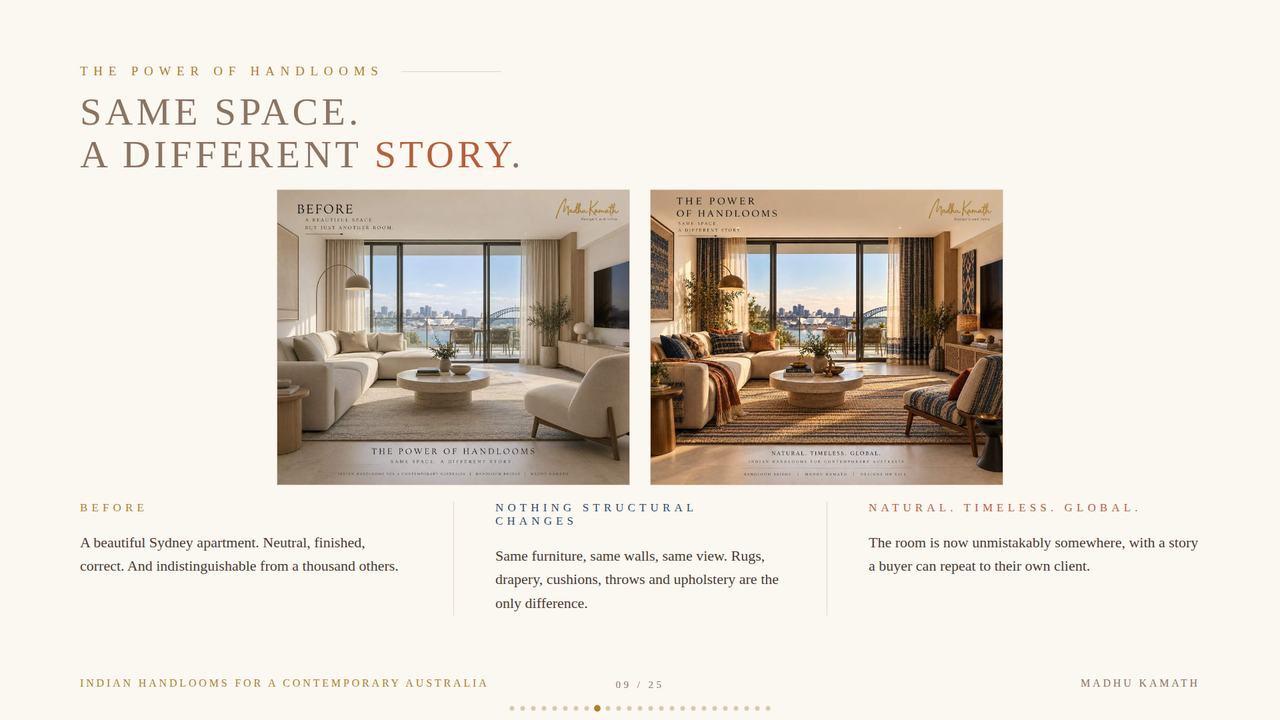
Same space.
A different story.
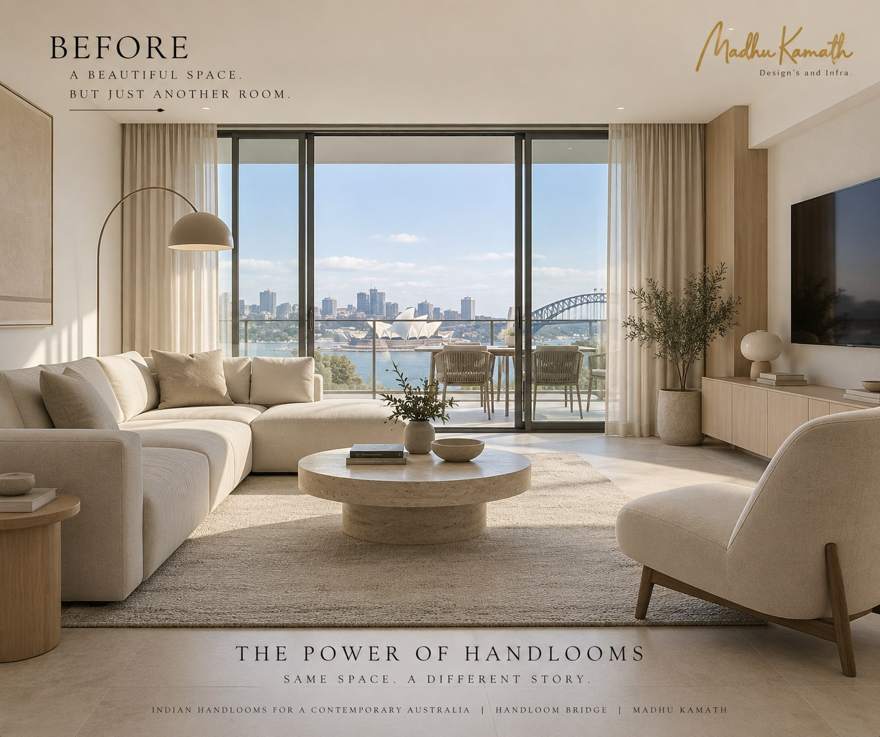
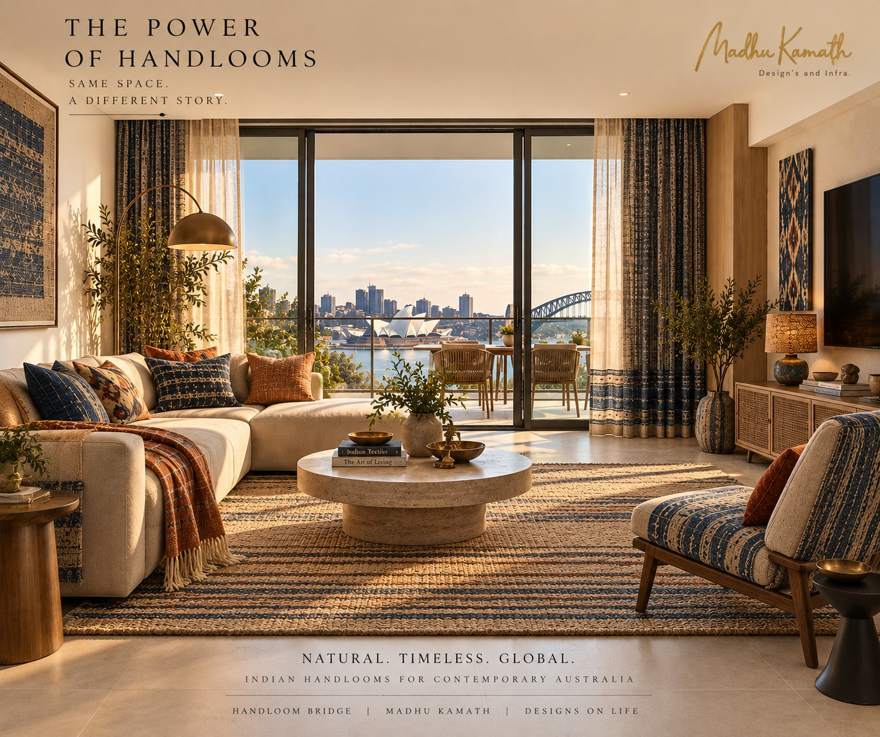
A beautiful Sydney apartment. Neutral, finished, correct. And indistinguishable from a thousand others.
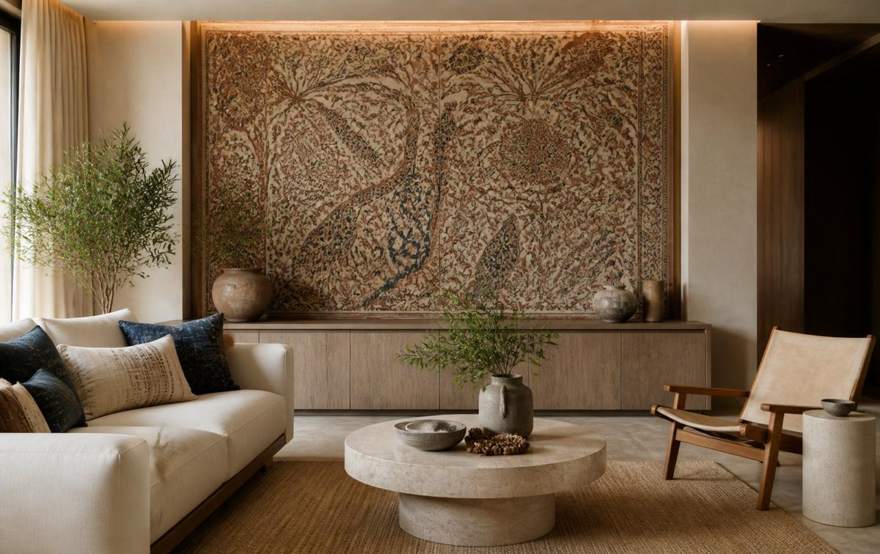
Same furniture, same walls, same view. Rugs, drapery, cushions, throws and upholstery are the only difference.
The room is now unmistakably somewhere, with a story a buyer can repeat to their own client.
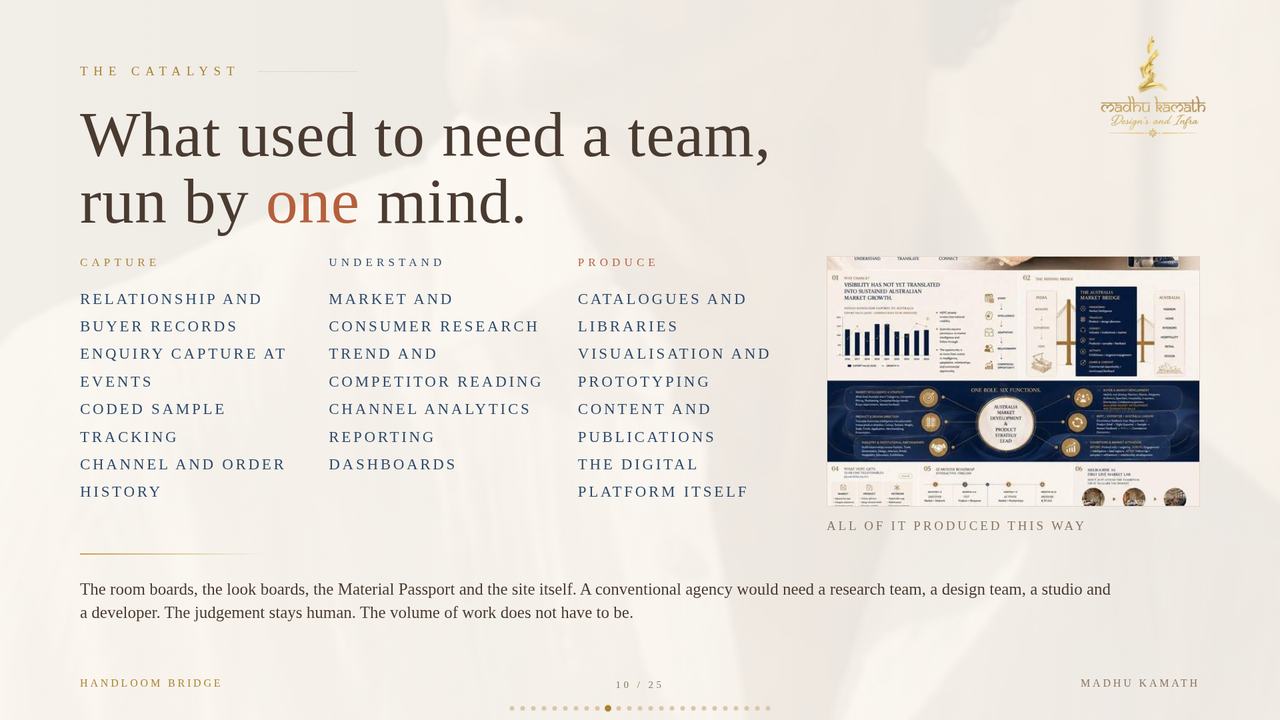
What used to need a team,
run by one mind.
Enquiry capture at events
Coded sample tracking
Channel and order history
Trend and competitor reading
Channel analytics
Reporting dashboards
Visualisation and prototyping
Content and publications
The digital platform itself
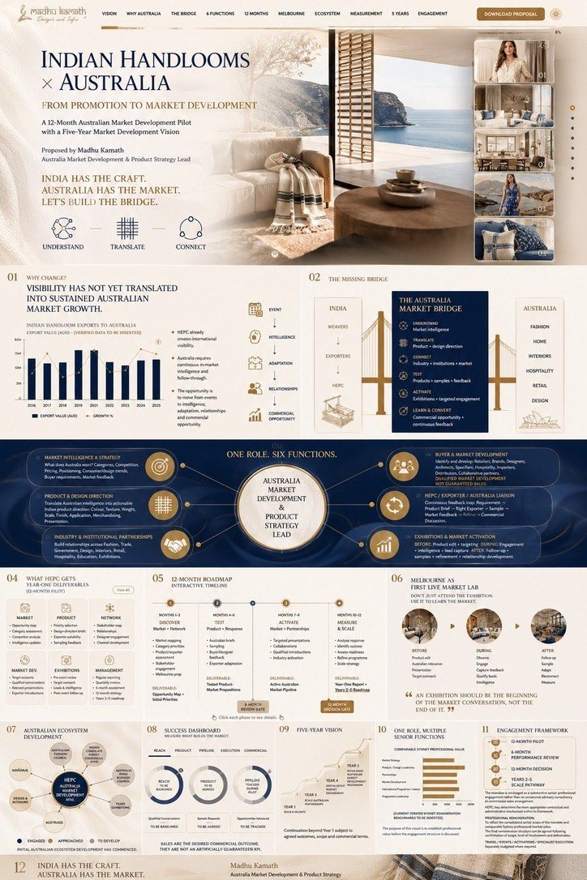
All of it produced this way
The room boards, the look boards, the Material Passport and the site itself. A conventional agency would need a research team, a design team, a studio and a developer. The judgement stays human. The volume of work does not have to be.
Thirty-seven years,
converging on one thing.
Interiors
Property and infrastructure
Entrepreneurship
Desktop publishing
Media and publications
Catalogues and exhibitions
Digital development
India, lived and worked
Australia, lived and worked
A conventional agency would need several specialists to cover this. For most of my working life these were separate chapters. AI is what let me bring them together into one continuous capability, and it is why this begins now rather than after a long build.
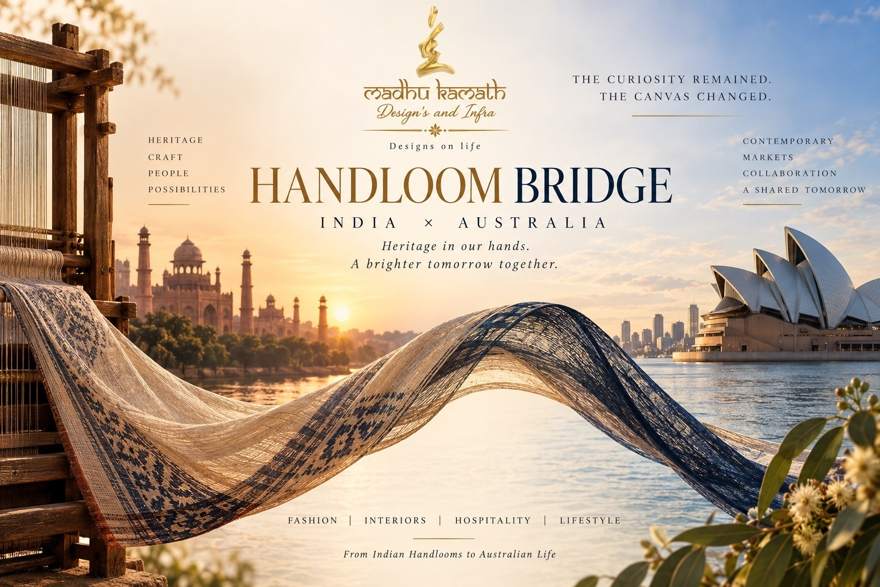
The curiosity remained. The canvas changed.
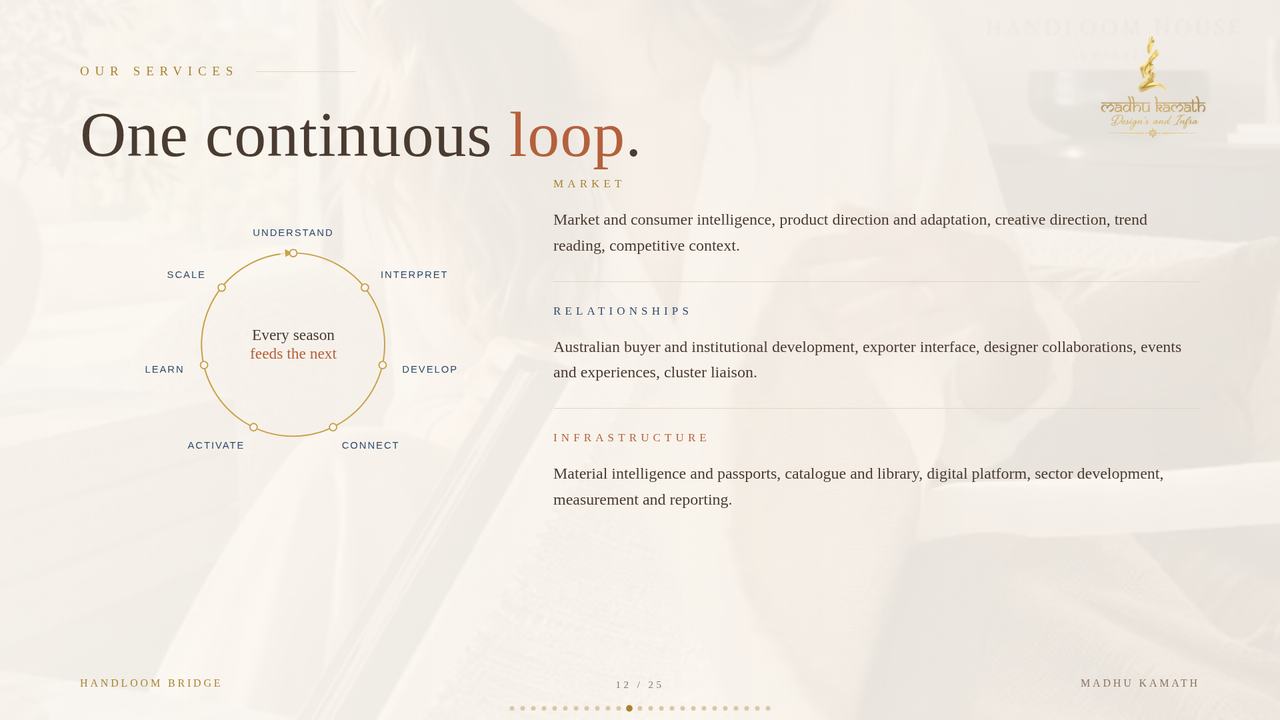
One continuous loop.
Market and consumer intelligence, product direction and adaptation, creative direction, trend reading, competitive context.
Australian buyer and institutional development, exporter interface, designer collaborations, events and experiences, cluster liaison.
Material intelligence and passports, catalogue and library, digital platform, sector development, measurement and reporting.
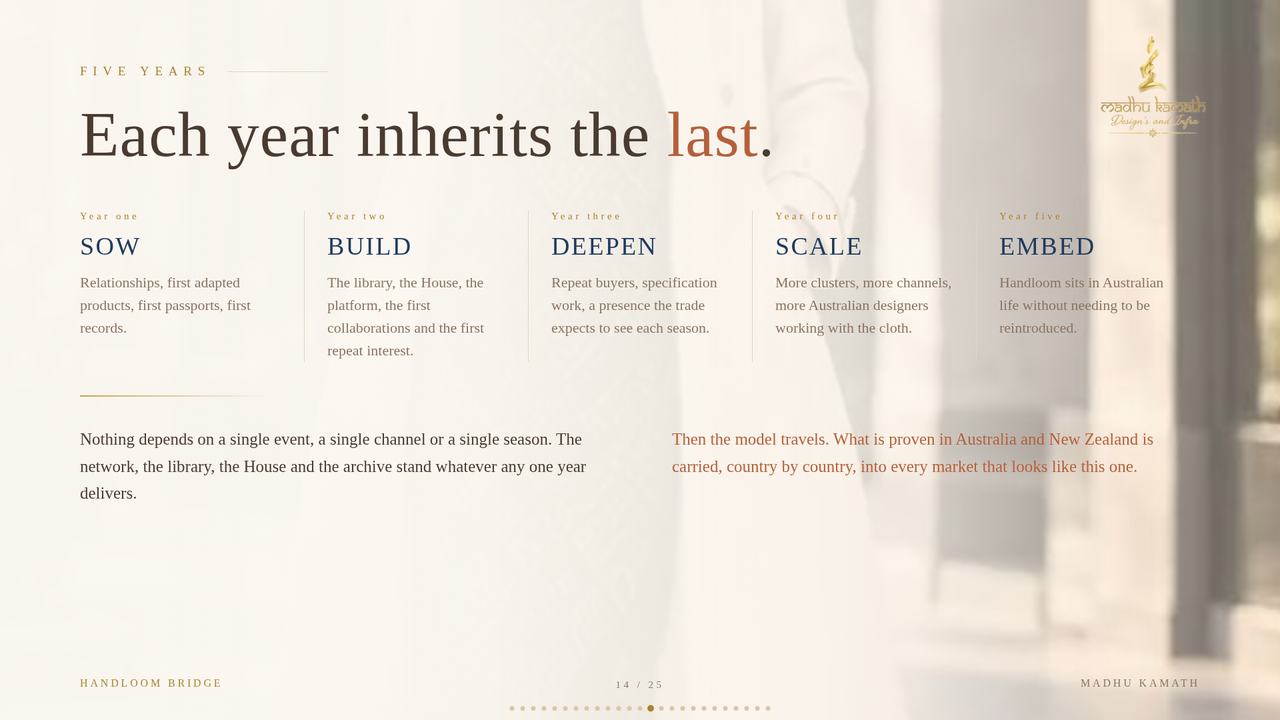
Each year inherits the last.
Nothing depends on a single event, a single channel or a single season. The network, the library, the House and the archive stand whatever any one year delivers.
Then the model travels. What is proven in Australia and New Zealand is carried, country by country, into every market that looks like this one.
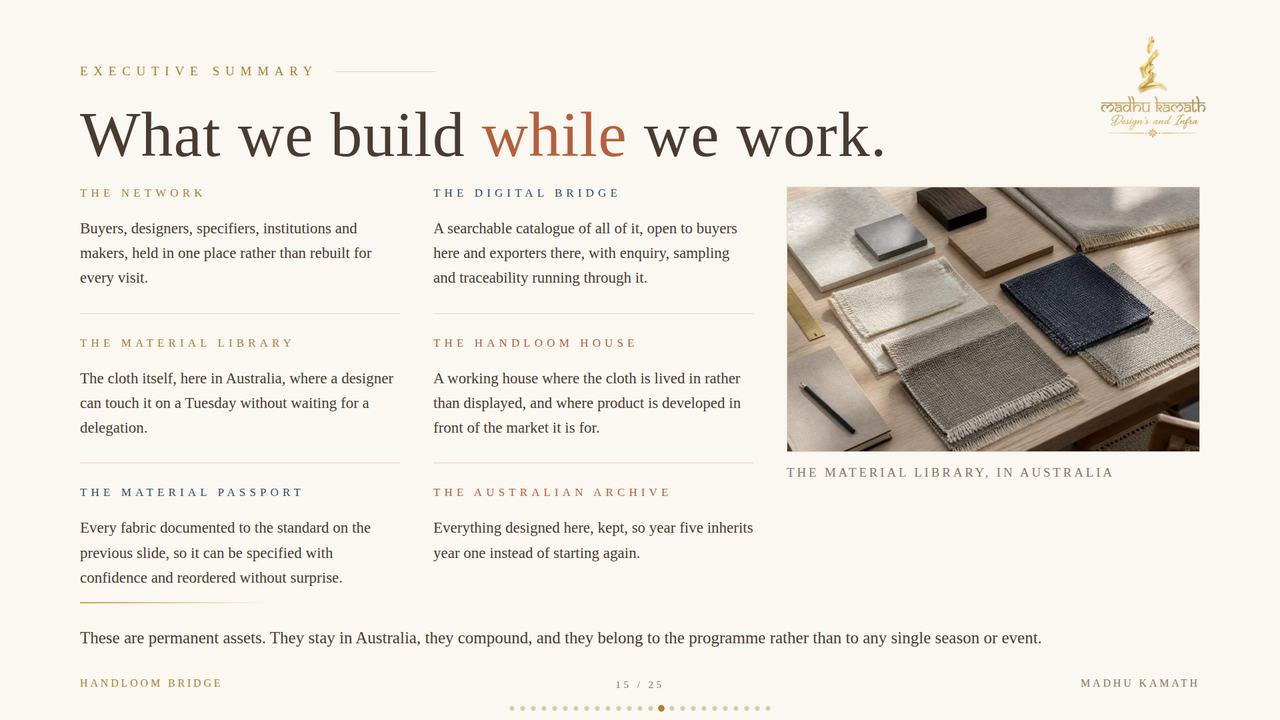
What we build while we work.
Buyers, designers, specifiers, institutions and makers, held in one place rather than rebuilt for every visit.
The cloth itself, here in Australia, where a designer can touch it on a Tuesday without waiting for a delegation.
Every fabric documented to the standard on the previous slide, so it can be specified with confidence and reordered without surprise.
A searchable catalogue of all of it, open to buyers here and exporters there, with enquiry, sampling and traceability running through it.
A working house where the cloth is lived in rather than displayed, and where product is developed in front of the market it is for.
Everything designed here, kept, so year five inherits year one instead of starting again.
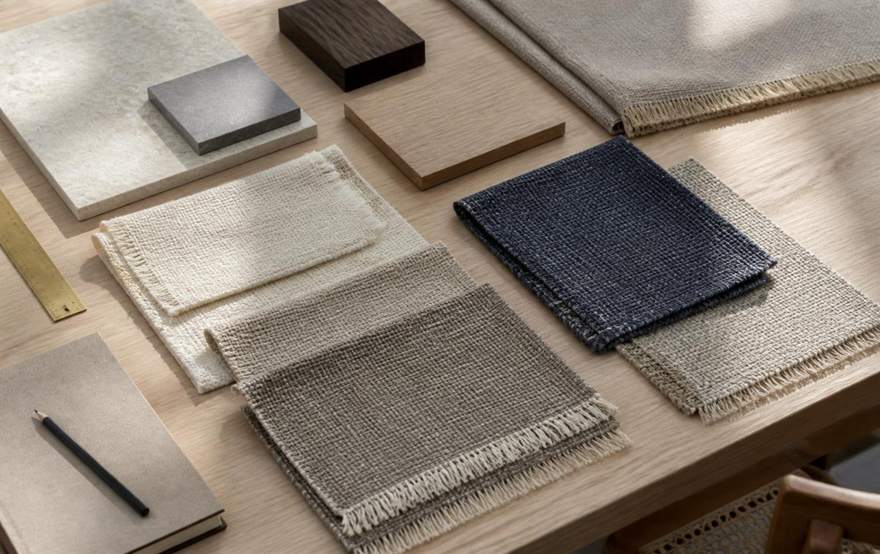
The Material Library, in Australia
These are permanent assets. They stay in Australia, they compound, and they belong to the programme rather than to any single season or event.
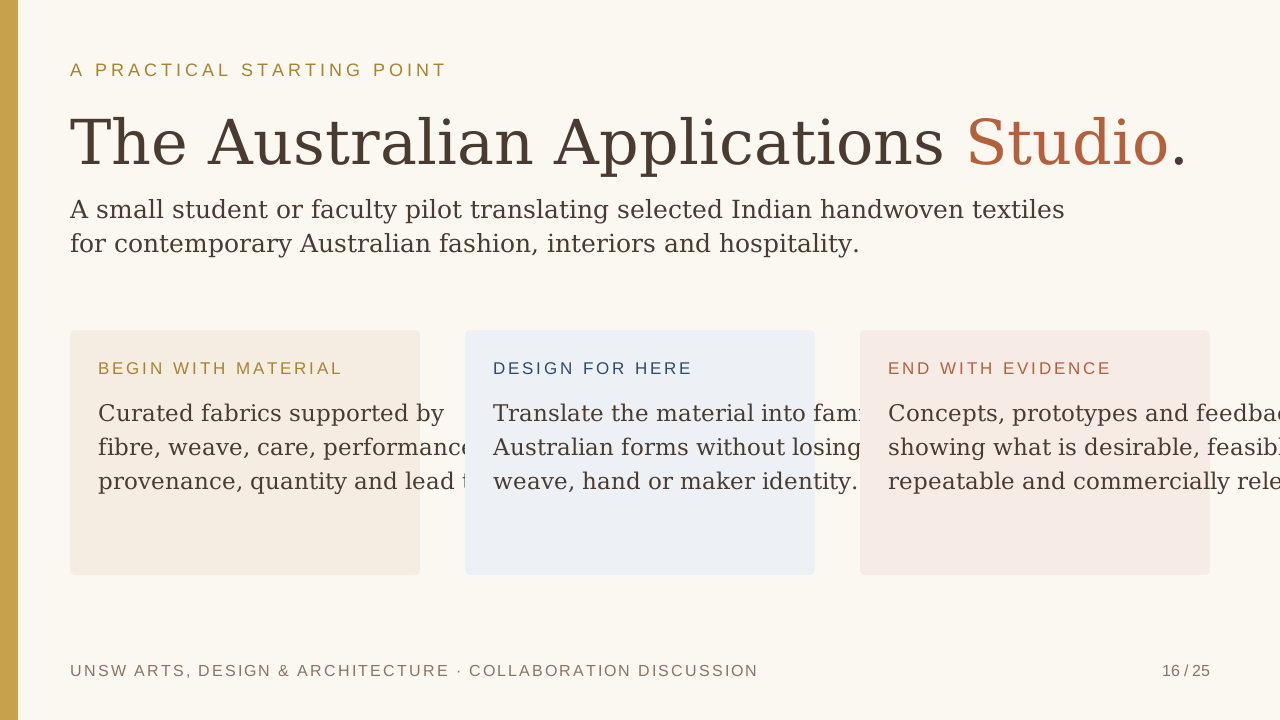
The Australian Applications Studio.
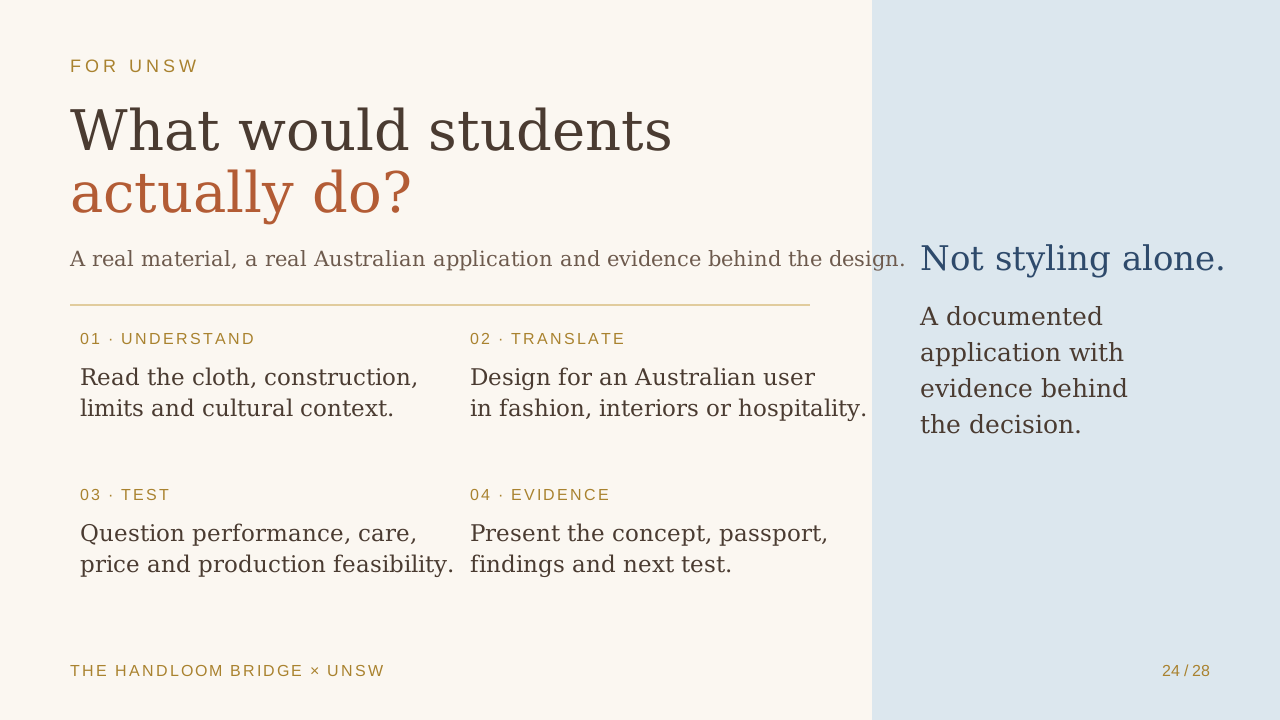
A small, clearly scoped student or faculty pilot exploring how selected Indian handwoven textiles can be developed for contemporary Australian applications across fashion, interiors and hospitality.
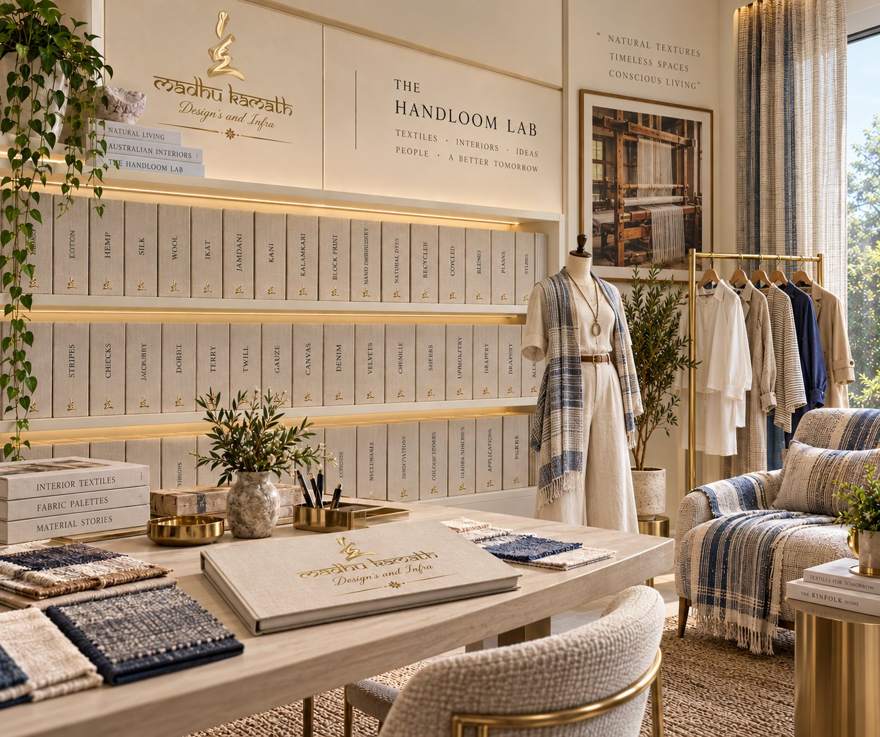
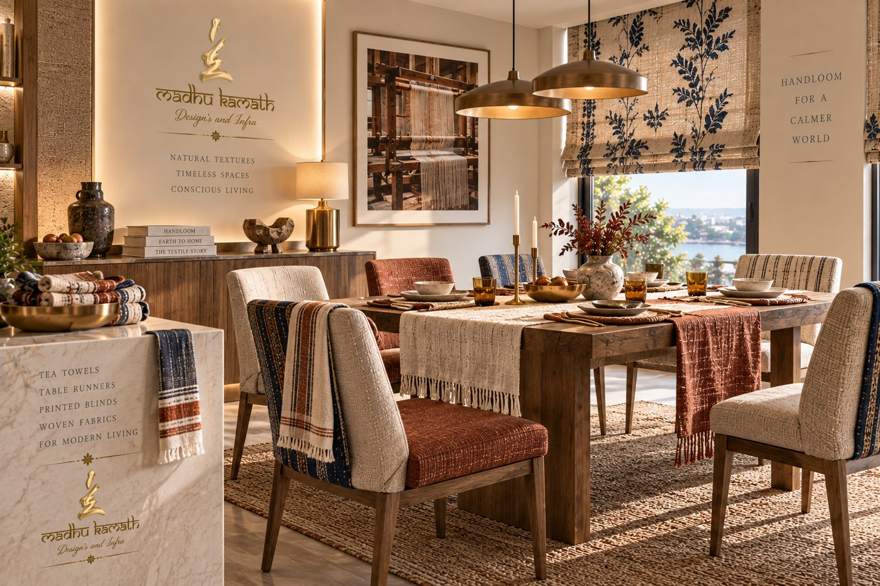
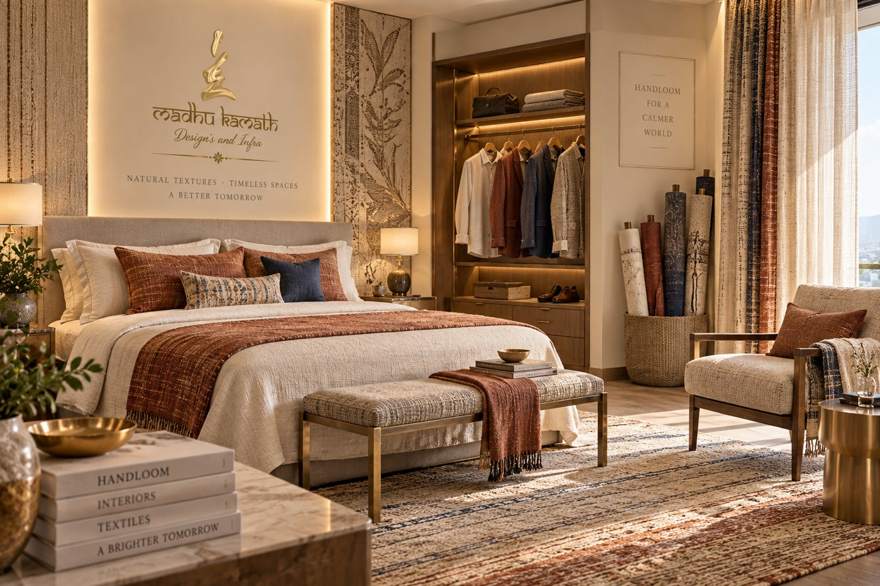
A curated group of fabrics, each supported by fibre, weave, care, performance, provenance, quantity and lead-time information.
Translate the material into familiar Australian forms and environments without losing the weave, hand, technique or maker identity.
Concepts or prototypes, industry feedback and a concise account of what is desirable, feasible, repeatable and commercially relevant.
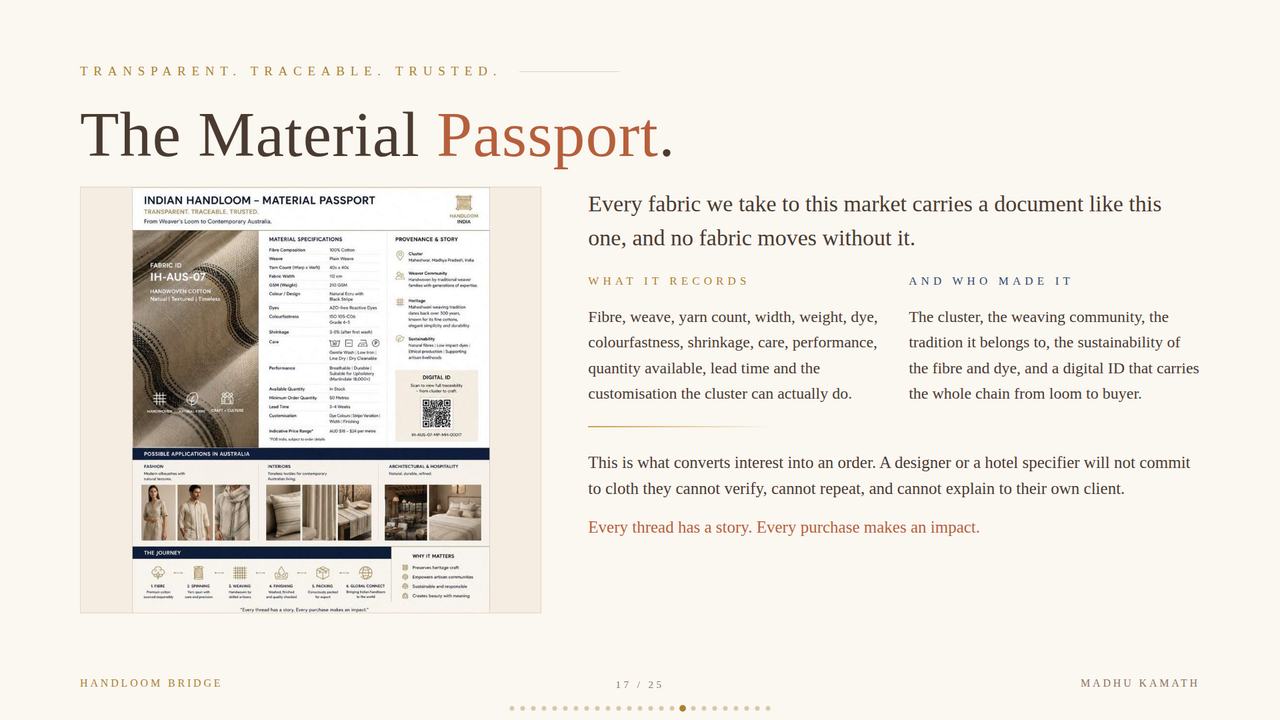
The Material Passport.
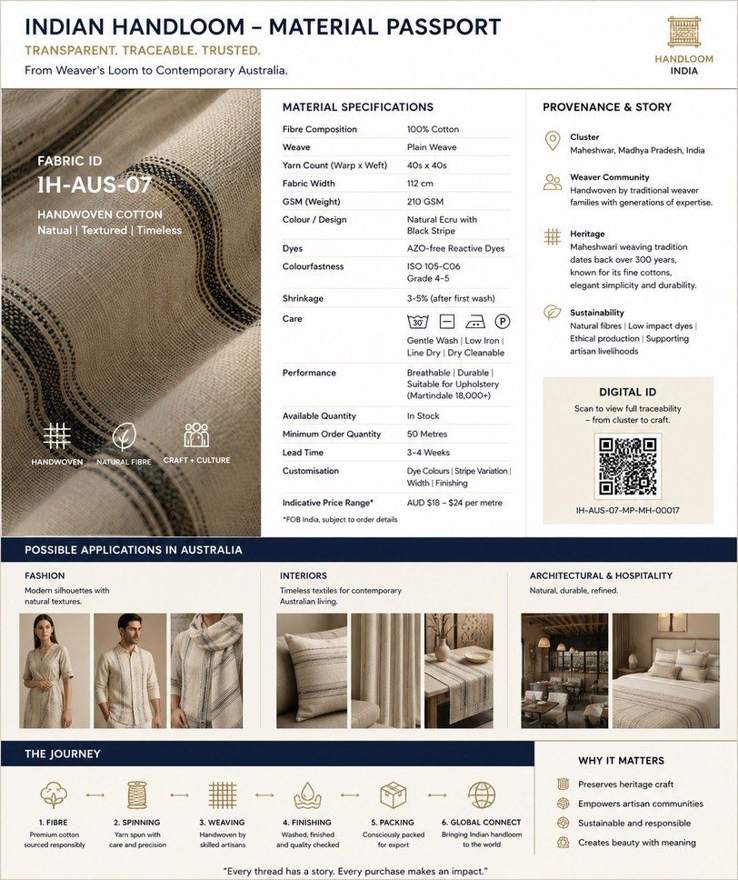
Every fabric we take to this market carries a document like this one, and no fabric moves without it.
Fibre, weave, yarn count, width, weight, dye, colourfastness, shrinkage, care, performance, quantity available, lead time and the customisation the cluster can actually do.
The cluster, the weaving community, the tradition it belongs to, the sustainability of the fibre and dye, and a digital ID that carries the whole chain from loom to buyer.
This is what converts interest into an order. A designer or a hotel specifier will not commit to cloth they cannot verify, cannot repeat, and cannot explain to their own client.
Every thread has a story. Every purchase makes an impact.
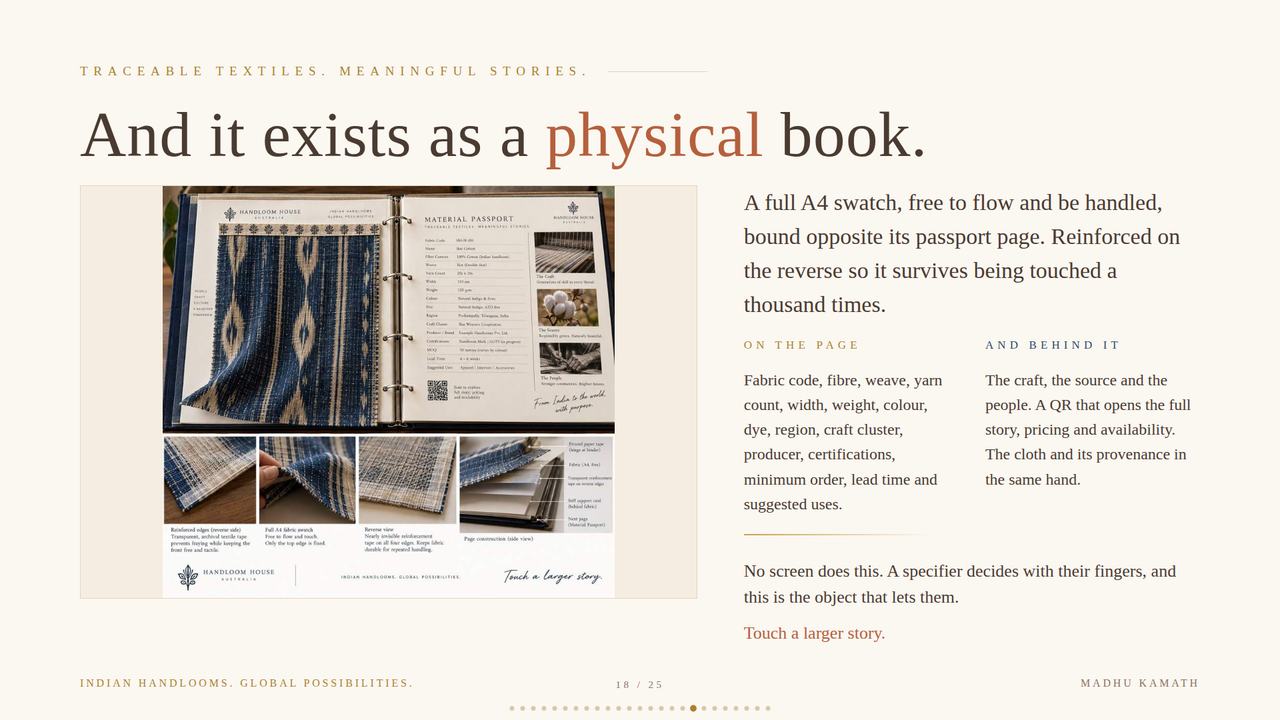
And it exists as a physical book.
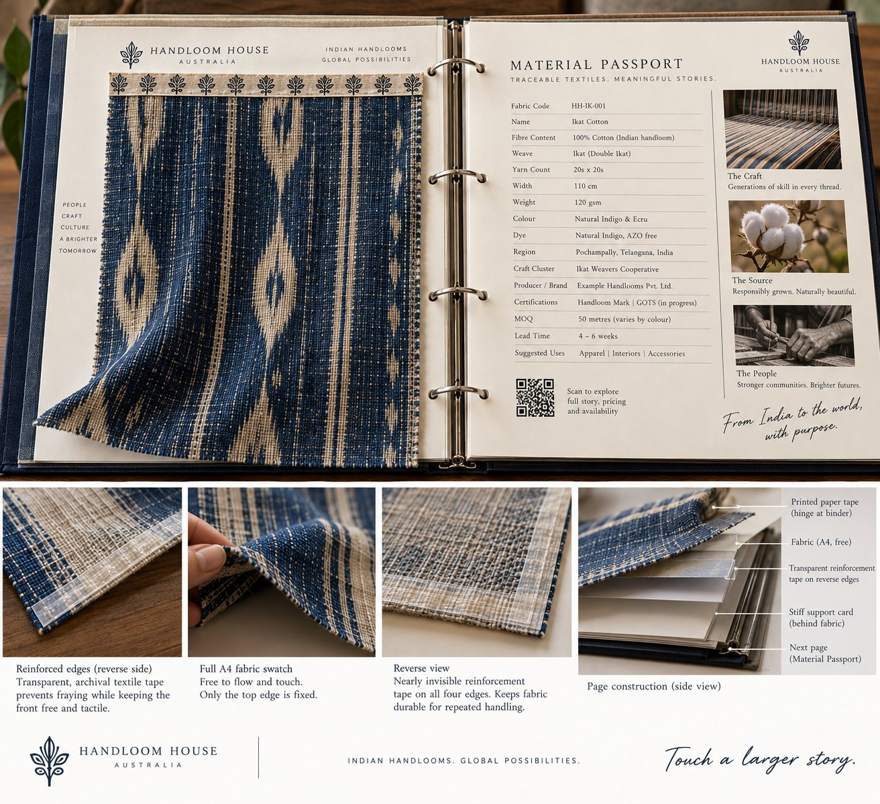
A full A4 swatch, free to flow and be handled, bound opposite its passport page. Reinforced on the reverse so it survives being touched a thousand times.
Fabric code, fibre, weave, yarn count, width, weight, colour, dye, region, craft cluster, producer, certifications, minimum order, lead time and suggested uses.
The craft, the source and the people. A QR that opens the full story, pricing and availability. The cloth and its provenance in the same hand.
No screen does this. A specifier decides with their fingers, and this is the object that lets them.
Touch a larger story.
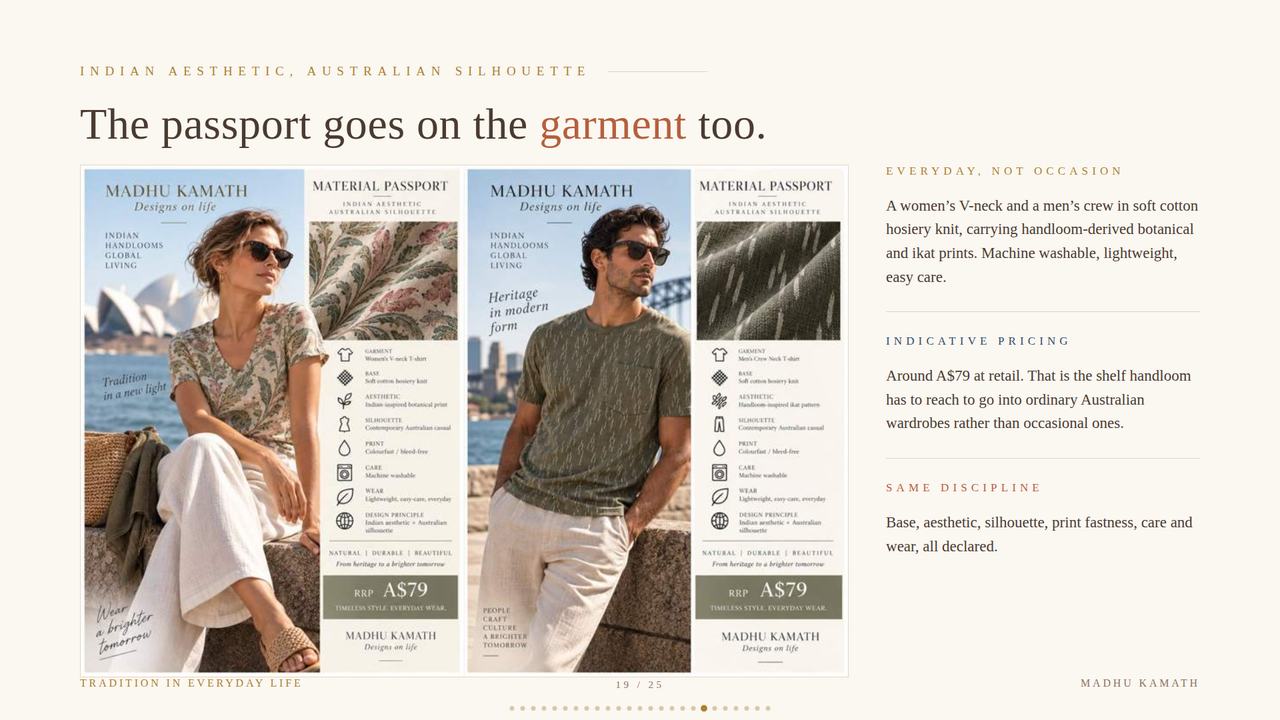
The passport goes on the garment too.
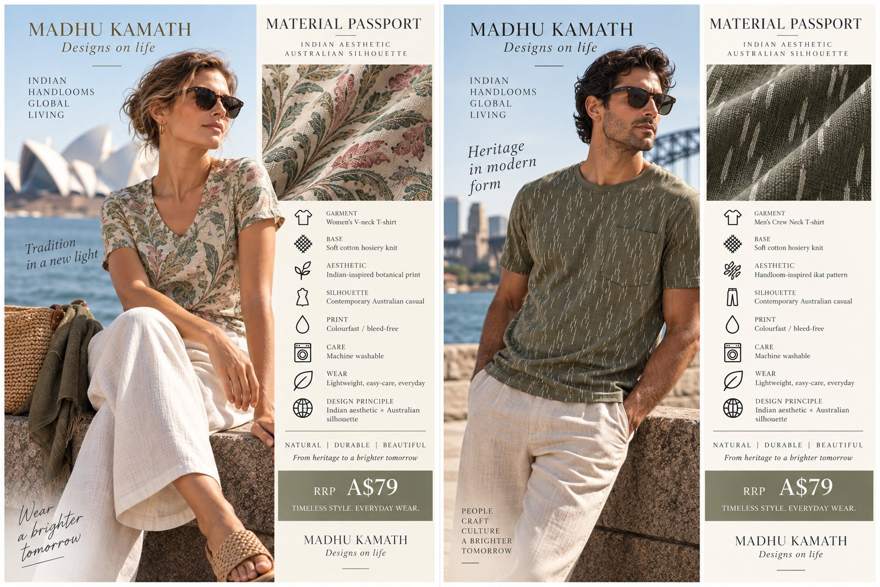
A women’s V-neck and a men’s crew in soft cotton hosiery knit, carrying handloom-derived botanical and ikat prints. Machine washable, lightweight, easy care.
Around A$79 at retail. That is the shelf handloom has to reach to go into ordinary Australian wardrobes rather than occasional ones.
Base, aesthetic, silhouette, print fastness, care and wear, all declared.
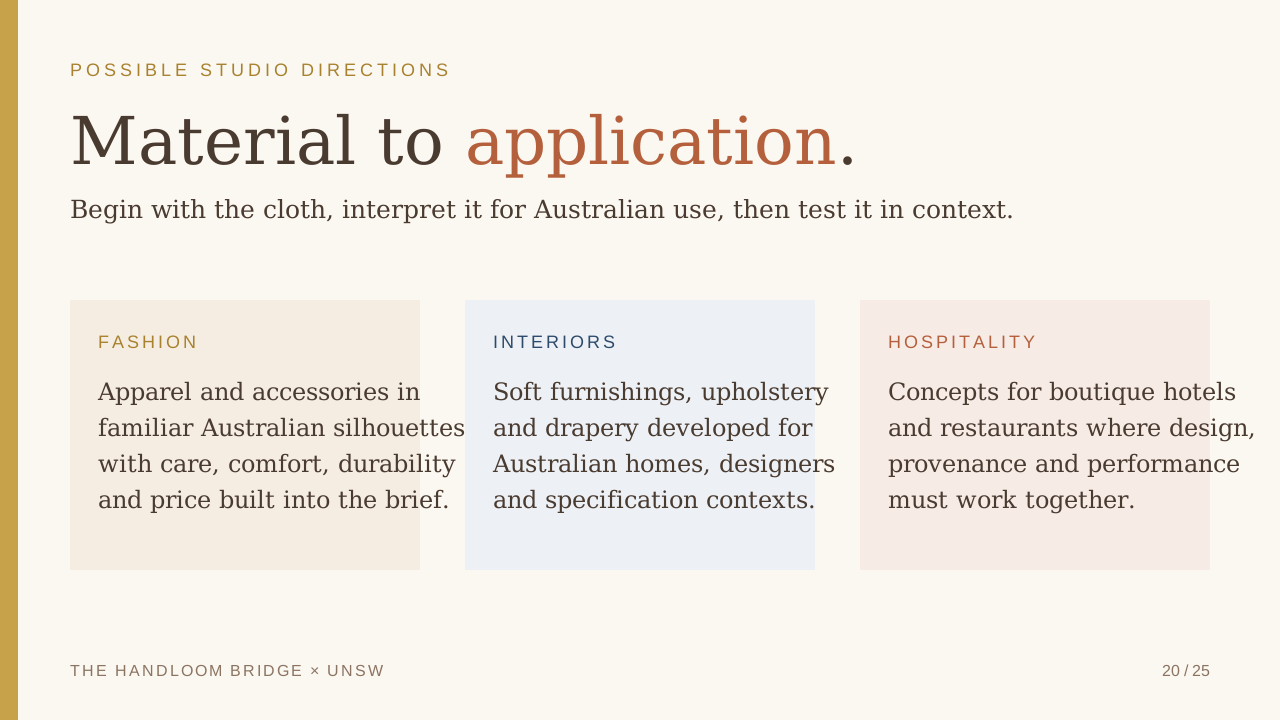
Material to application.
Students begin with the cloth, its capabilities and its limits. They interpret it for Australian use, then test the result against real people, spaces and industry expectations.
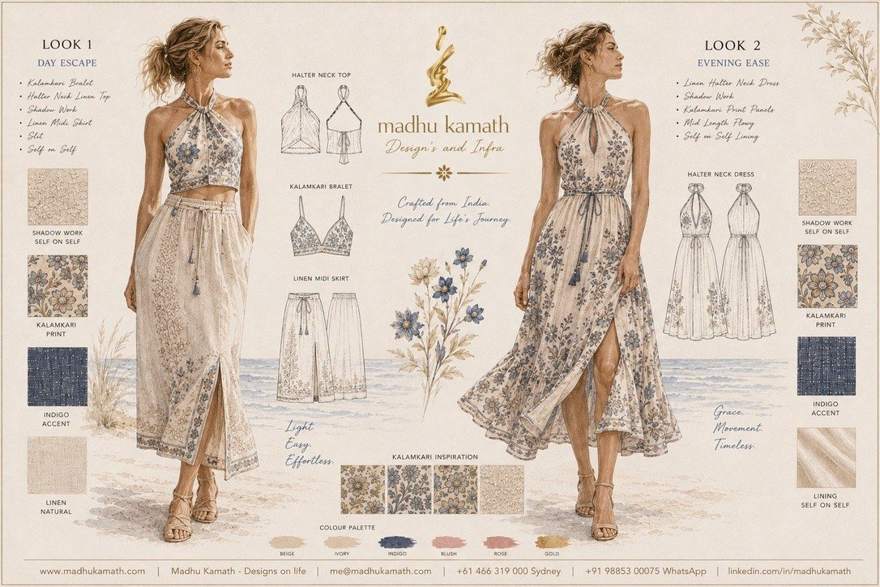

Contemporary apparel, accessories and familiar Australian silhouettes, with care, comfort, durability and price considered from the first sketch.
Soft furnishings, upholstery, drapery and material applications developed for Australian homes, designers and specification contexts.
Focused concepts for boutique hotels, restaurants and considered environments where provenance and performance must work together.
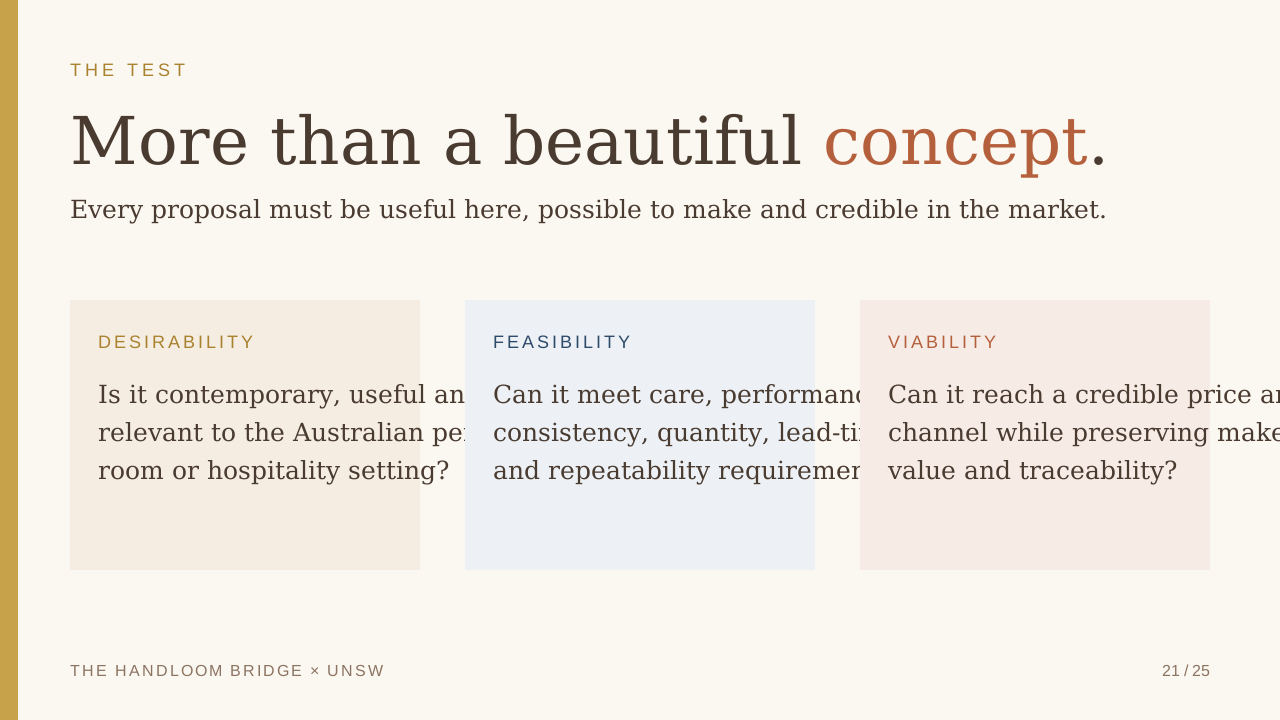
More than a beautiful concept.
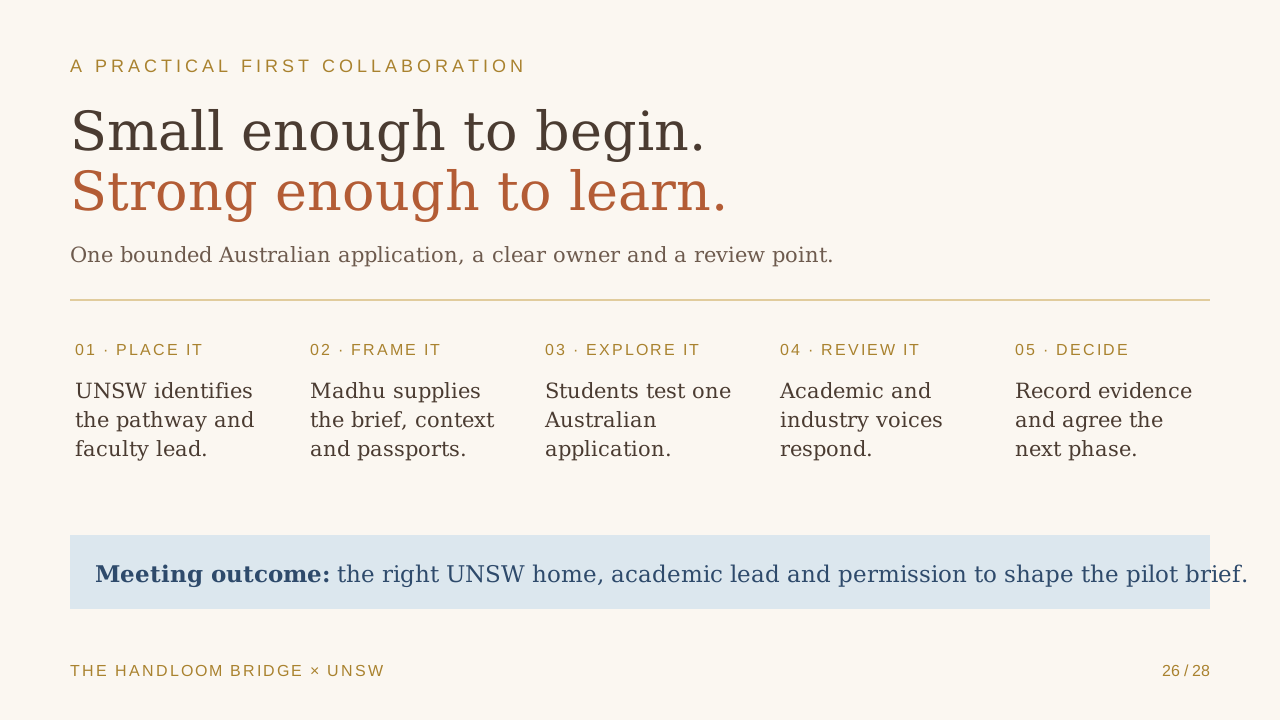
The pilot must ask whether each proposal is not only visually strong, but suitable for Australian use, possible to produce and credible in the market.
Does the application feel contemporary, useful and relevant to the Australian person, room or hospitality setting it is designed for?
Can the material meet requirements for care, performance, consistency, quantity, customisation, lead time and repeatability?
Can the concept reach a credible price and channel, with traceability and maker value preserved rather than added as decoration?
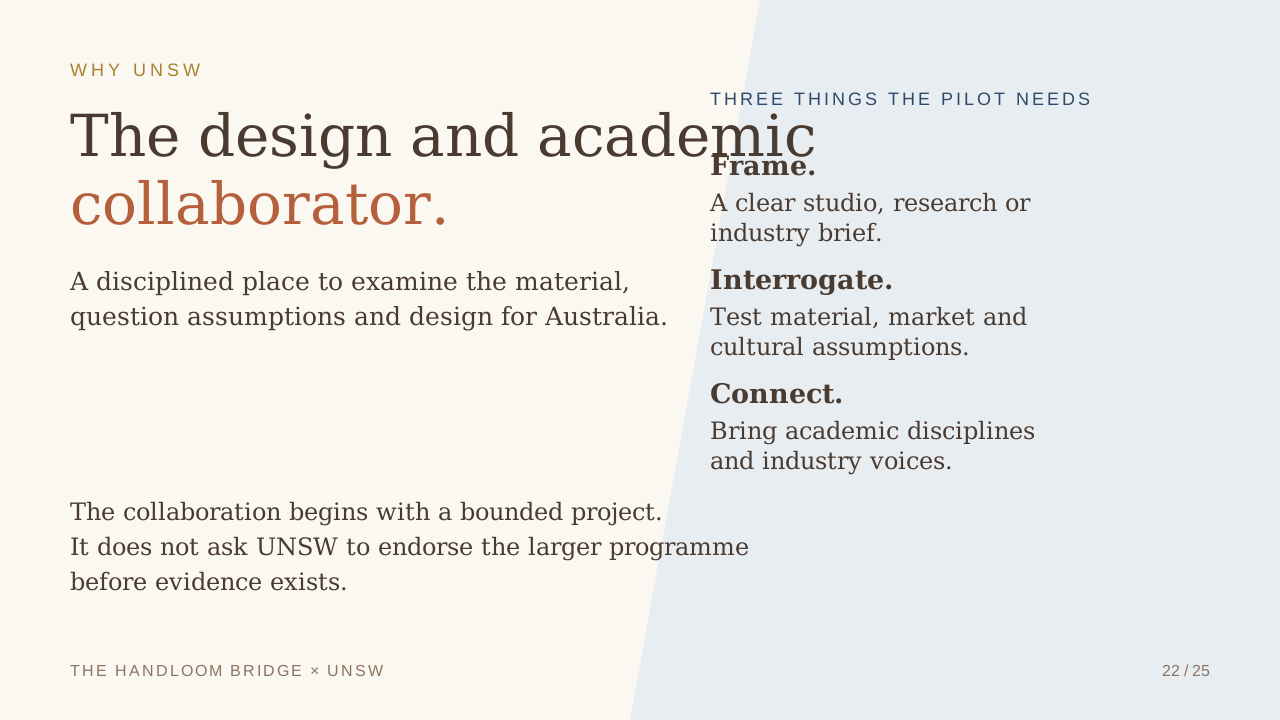
The design and academic collaborator.
The missing link is not another exhibition. It is a disciplined place to examine the material, question assumptions and design for the Australian context.
UNSW can bring academic structure, critical inquiry, design exploration and access to students, faculty and relevant industry relationships.
The collaboration begins with a bounded project. It does not require UNSW to endorse the larger programme before the evidence exists.
Knowledge exchange first. Research and industry collaboration as the evidence develops. Internships may follow later, but they are not the present proposal.
Frame. Turn the opportunity into a clear studio, research or industry brief with appropriate learning and inquiry.
Interrogate. Test sustainability, traceability, cultural context, performance, product-market fit and the assumptions on both sides.
Connect. Invite relevant academic disciplines and selected industry voices to respond to the work and strengthen the findings.
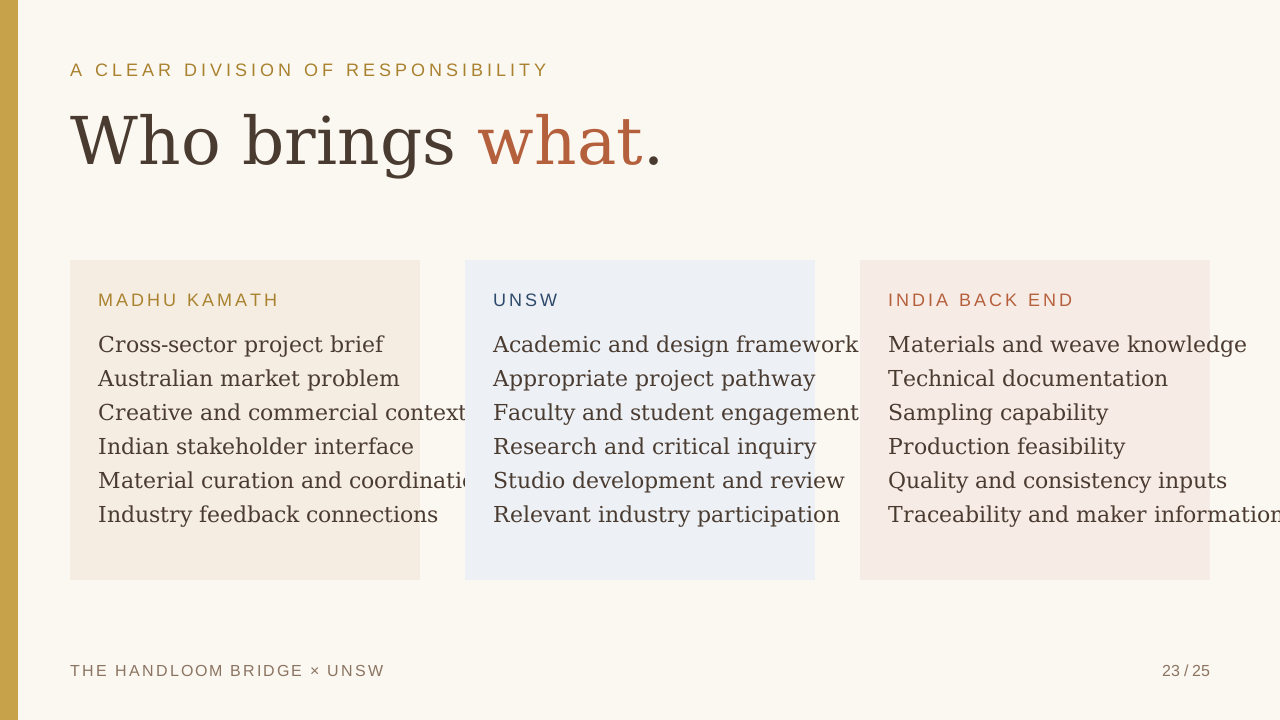
Who brings what.
Australian market problem
Creative and commercial context
Indian stakeholder interface
Material curation and coordination
Industry feedback connections
Appropriate project pathway
Faculty and student engagement
Research and critical inquiry
Studio development and review
Relevant industry participation
Technical documentation
Sampling capability
Production feasibility
Quality and consistency inputs
Traceability and maker information
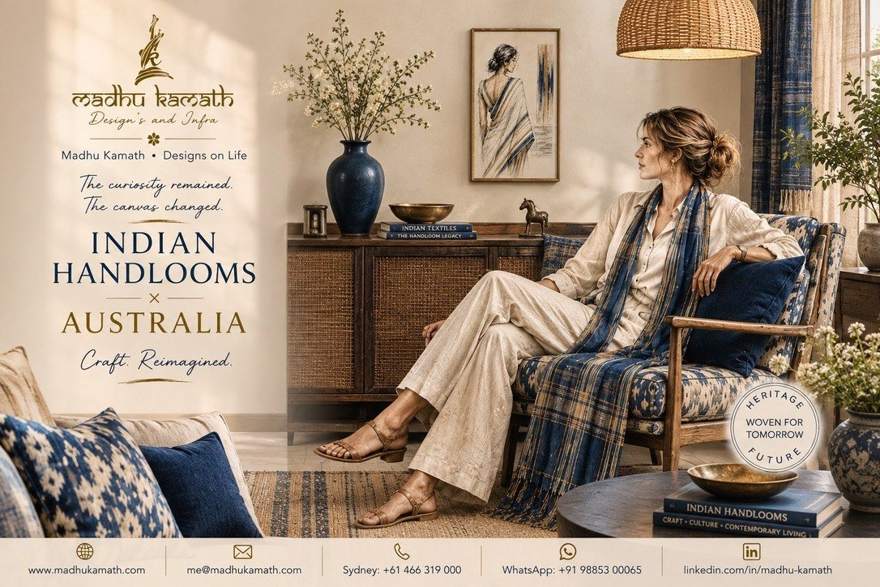
What the doors are for
UNSW is not being asked to organise production or manage the weaving ecosystem. Its role is to help shape and test a credible design and academic collaboration.
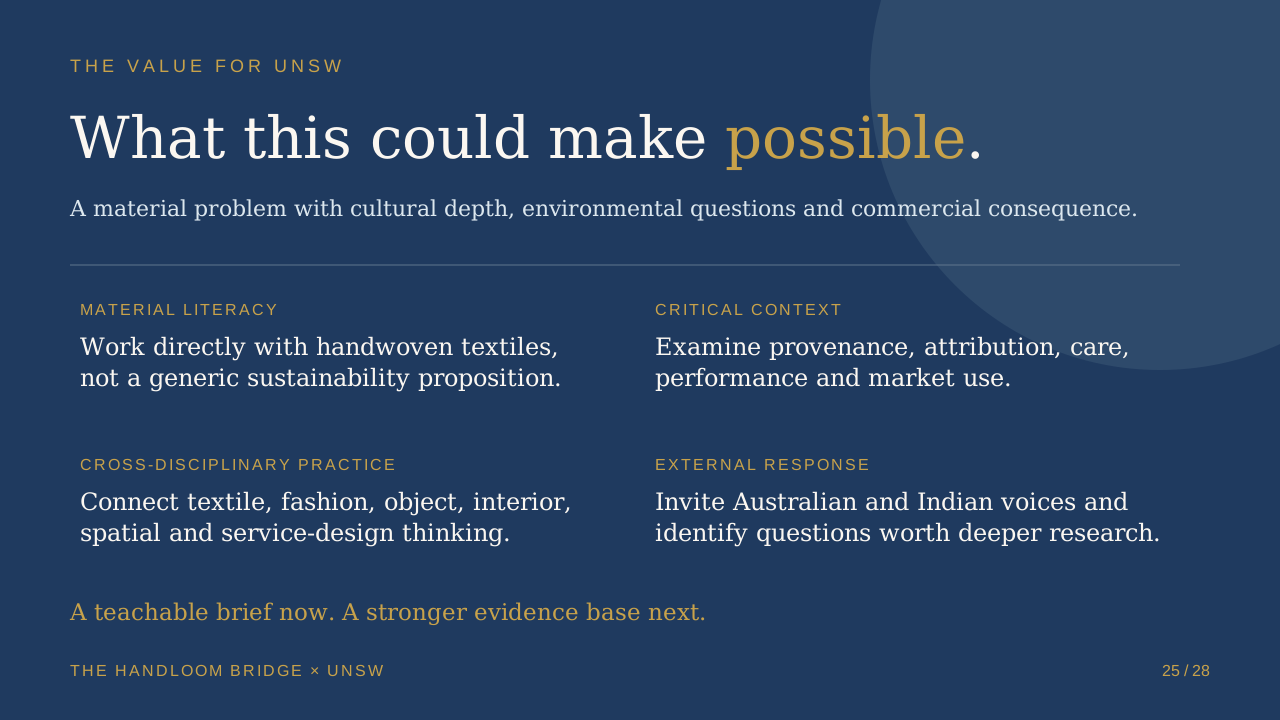
What this could make possible.
A real cross-disciplinary brief gives students and faculty a material problem with cultural depth, environmental questions and commercial consequence.
Material literacy. Work directly with handwoven textiles rather than a generic sustainability proposition.
Critical context. Examine provenance, cultural attribution, care, performance and the tension between craft value and market use.
Cross-disciplinary practice. Connect textile, fashion, object, interior, spatial and service-design thinking around one material system.
External response. Put selected work before relevant Australian and Indian industry voices and identify questions worth deeper research.
Potential value: a teachable brief now, a stronger evidence base next, and only then a decision about research, WIL or a longer collaboration.
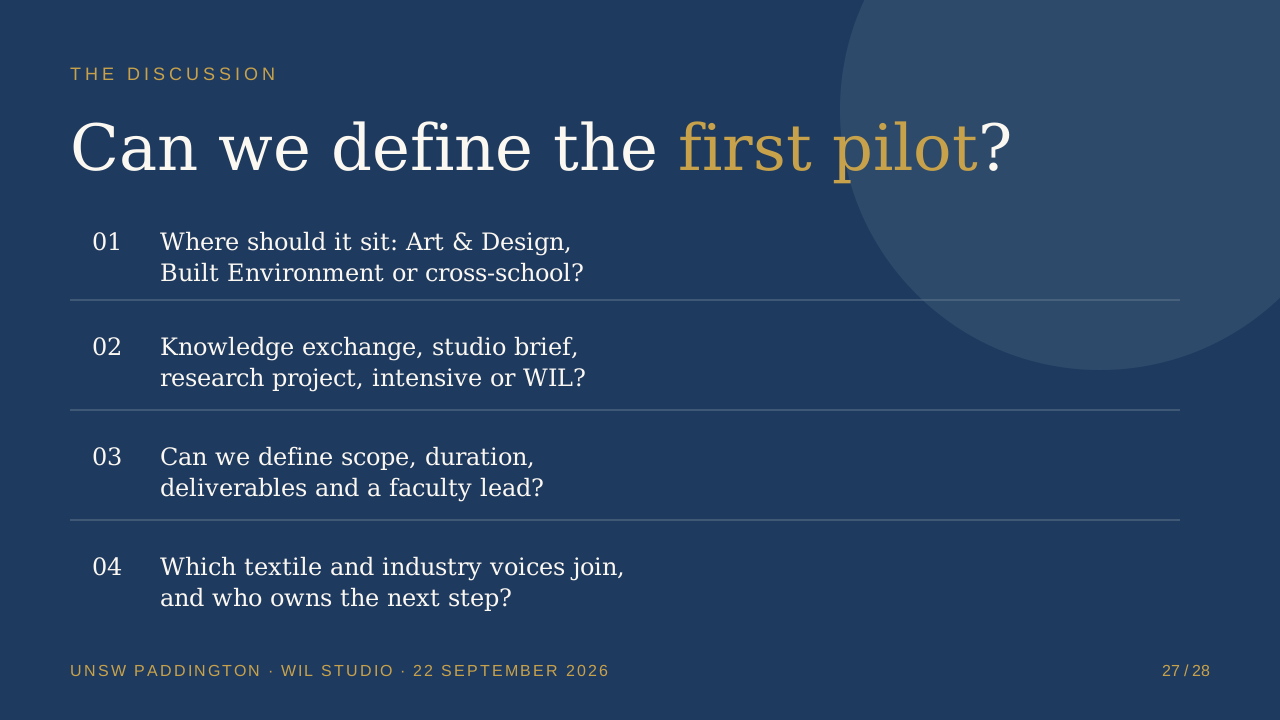
Can we define the first pilot?
Designs on Life
The Handloom Bridge · India × Australia